
Why "The Internet of Value" ?
Can You and I create a better Internet?

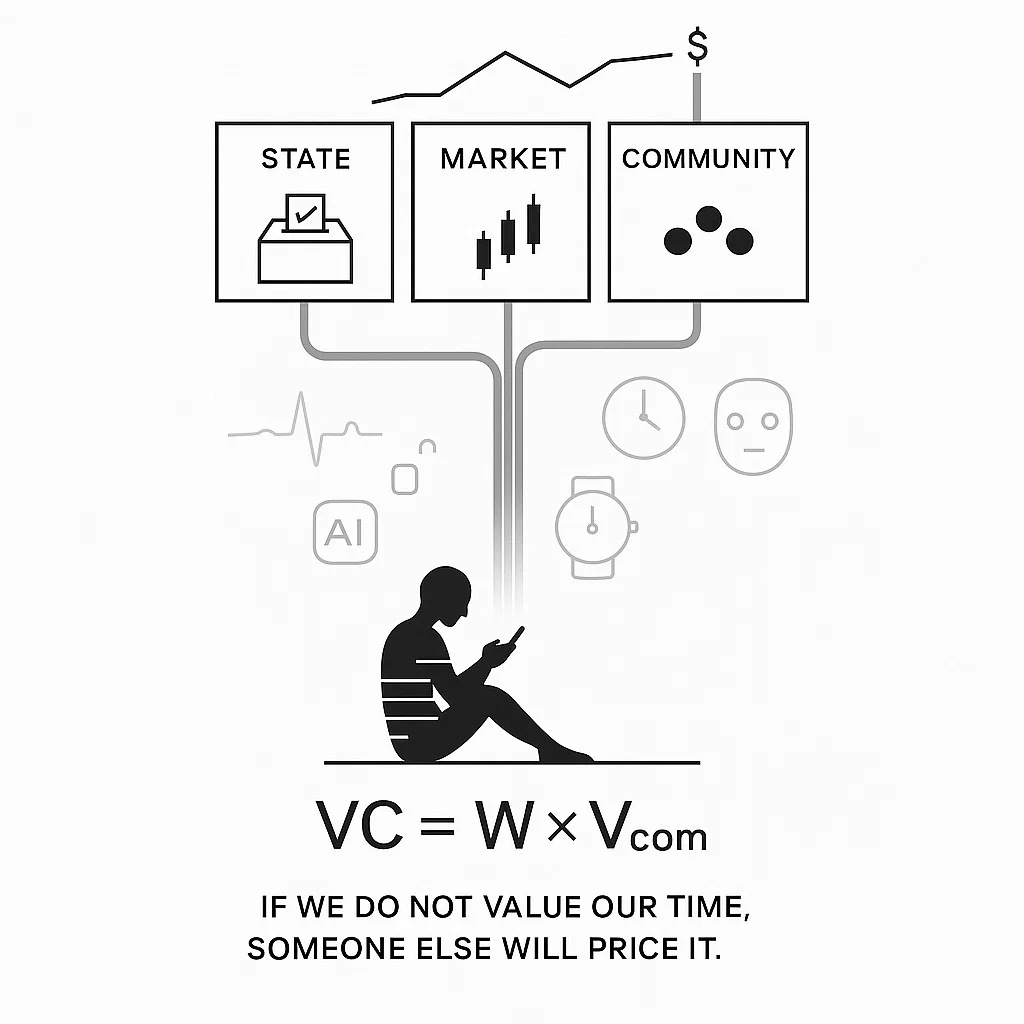
Follow the Packet, Not the Money
It is 07:29 P.M.
We’re on our phone. We tap a familiar icon, the blue purple blur of Instagram or the red splash of Youtube. The thumb knows the route better than the mind.
Home feed.
First reel, a cat in sunglasses falls off a couch in slow motion.
On the surface, nothing happens.
The face is blank. The thumb flicks. The reel is gone in under three seconds.
Next reel, a woman appears.
She looks almost real.
Perfect skin, perfect lighting, perfect micro expressions. She laughs at a joke that does not exist, tilts her head, holds eye contact with the camera in a way that feels engineered to land somewhere between comfort and flirtation.
Our body reacts before our brain finishes the sentence.
Then the question slips in.
Is she real?
Is this an actress?
Is this a model?
Is this a synthetic face with a rented personality, generated on a cloud GPU so that some marketing intern can hit quarterly lead targets?
The thumb hovers for a second.
The tiny part of the mind that still cares about reality whispers,
“Should we be worried that we are turned on by a file named hotgirl_flirty_final2.png?”
The rest of the mind replies,
“Who has the time to investigate? Next.”
Thumb flick. New reel.
Inside the phone, everything happens at once.
The moment the app opens, a session begins. That session attaches to a long tail of data:
device model
operating system
location, at least to the city block
phone number history, ad ID, past purchases
previous watch patterns, pauses, rewatches, rage quits
what kind of faces we linger on, human or synthetic, and how long
Invisible timers start ticking. How many seconds in this session? How many reels. How many ads. How many pixels of cleavage before the thumb moves.
The phone speaks to the router.
The router speaks to the local tower.
The tower speaks to cables and repeaters that do not care about borders.
Packets sprint into a data centre where football fields of machines specialise in one thing, shaping the next reel to keep the session alive a little longer.
The phone is not even the whole story. On the wrist, a smart watch streams heart rate, sleep debt and step count. A glucose patch quietly reports how our blood handles late night sugar. A smart speaker in the corner listens for wake words while learning the texture of our days. The TV, the car, the lift in the building produce their own logs. We think we opened one app for a few minutes. In practice, our entire body and home act like a stitched together telemetry suit that feeds the same information highway. That eventually hops from our phone to the wifi to the local telephone tower to miles of fibre optic cables to a server room. Which is nothing but a bunch of machines waiting for the food i.e. packets of data.
On those machines, algorithms wake up.
They do not know the person’s name in any human way. They know the profile as a pattern.
age bracket, income bracket, education bracket
preferred content archetypes, pets, gossip, politics, thirst, self help, outrage
likelihood to skip ads, save posts, share, buy
sensitivity to faces, bodies, styles, even to specific skin tones and jawlines
The model places a tiny bet.
Show another animal. Then two human faces. Test one clearly human creator and one clearly artificial beauty. Track which one holds the retina longer. Reduce politics. Increase shopping content after two or three emotional spikes.
On the screen, it is just one more flick.
Behind the screen, those few seconds join a river of data that flows into the company dashboards:
daily active users
average watch time per session
ads watched per minute
click through rates on different categories
revenue per user in that geography
Those numbers become charts.
Those charts become slides.
Those slides land in investor calls where executives say sentences like:
“Our average daily time spent increased by thirty four seconds in this quarter. We see strong engagement with our new AI assisted creator tools in the twenty five to thirty four segment.”
Translated into plain language, we squeezed more minutes and more emotion out of the same humans.
From there, the chain extends.
Analysts in banks and funds feed those slides into their models. They update revenue forecasts, growth assumptions, target prices. Traders place orders based on whether they believe the river of attention will rise faster or slower than the consensus line.
On top of the shares, more layers grow:
options that bet on whether the company will beat or miss earnings next quarter
products that pay out if volatility spikes around results
index weights that decide how much pension money flows into the stock
crypto style tokens, loyalty points, creator coins that ride on the same attention flows
prediction markets where people bet on the company’s future, on regulations around AI, on whether this platform will be banned in one country and boosted in another
Some of these markets run on regulated exchanges.
Some run on newer platforms where users can literally wager on questions like,
“Will short form video platform X hit Y million users by the end of the year”
“Will government Y pass law Z on data or AI by date T”
Real money rides on our collective tap habits.
Weeks before that one cat reel and that one synthetic face, someone had already sold and bought risk on the session that would contain them. Our boredom has a futures market. Our arousal has a price feed. Our confusion about what is real has a line chart.
Somewhere, a marketing team runs an experiment to see whether AI generated influencers can outperform human creators on cost per click. Somewhere else, a prediction market lets strangers bet on whether regulators will do anything meaningful about any of this.
On the same phone, in the same app, we scroll to a post that declares:
“Black Mirror is not fiction anymore.”
We double tap, share it to a friend, and go to sleep.
Next day, we do the same dance on YouTube Shorts, on Netflix’s endless rows, on every app that swaps a “next episode” or “next clip” for a goodbye.
If we strip the poetry away, the architecture is simple.
our time is sliced into moments
those moments become engagement metrics
those metrics become revenue projections
those projections become financial and betting products
those products are traded far away from our actual lives, on both traditional markets and crypto style platforms
We live inside an Internet that has already turned attention into an asset class. Our twenty four hours are quietly priced, packaged and sold without consent and without our well being in the equation.
This is where the institutions enter, not as saviours, but as different kinds of plumbers.
The State – running elections on rented feeds
States see the same river and panic for different reasons.
Some worry that all this data, which rides on our time, leaves the country, sits in foreign servers and becomes foreign leverage. So they draft data localisation laws. They announce:
“National data must stay within national borders.”
Data centres are built. Compliance teams grow. Forms multiply.
Our session still gets sliced into seconds.
The same models still run on top.
The same river of attention still feeds the same financial and betting expectations, only now a chunk of the hardware sits inside national borders.
The State has changed the plumbing, not the equation.
On paper, privacy looks protected. Laws carve the world into categories like “personally identifiable data” and “anonymised data.” Forms ask for consent in legal dialect few people ever read. We tap “accept” just to see the thing we came for. Databases dutifully mask or tokenise names, phone numbers and ID fields.
The problem is simple. Most of these rules guard individual rows in a table while modern algorithms learn from rivers. They do not need our name or Aadhaar number to know us. Given enough clicks, pauses, heart rate spikes, locations and purchase trails, models can predict what we will do next better than we can.
Behavioral scientists design the hooks. Machine learning engineers scale them to learn them under supervision or without it. Regulators tidy up column labels and retention policies. Privacy becomes a polite ritual wrapped around a system that has already profiled us in practice.
At the same time, politics quietly surrenders to the very platforms it claims to regulate.
candidates obsess over follower counts and engagement as if these are proofs of leadership
staffers build strategy around trending sounds and edited clips, not policy literacy
parties test slogans on the same feeds that sell diet plans and skin cream
Elections start to feel less like civic processes and more like seasonal influencer campaigns. A politician with shallow policy depth but sharp meme instincts can outcompete a boring, competent bureaucrat because the algorithm rewards heat, not nuance.
Layer on top of that the new markets that let anyone bet on political outcomes, laws, even wars.
Will candidate X win?
Will party Y cross a certain seat count?
Will conflict Z escalate by a given date?
These are not theoretical questions in a classroom. On some platforms they are literal markets where every rumour, every viral clip, every scandal can move odds and money.
We end up with:
representatives who know how to farm outrage but cannot read a budget sheet
cabinets that fear trending hashtags and prediction odds more than long term indicators
policy debates compressed into thirty second edits with dramatic music, because every extra second of nuance risks a drop in watch time
No law asks a basic question, how many hours of citizen attention can be turned into anger and anxiety before democracy itself becomes ungovernable, and how many basis points of profit that destruction is worth to someone.
There is no statutory ceiling on collective cortisol.
So the State stands in front of cameras talking about sovereignty, culture and national interest, while its own survival depends on playing the same engagement game as everyone else.
The State regulates where the data sleeps and how it is labelled.
The algorithm and the odds decide who gets to sit in office.
The Market – attention as raw material
Markets see the same river and call it opportunity.
Capital flows into companies that can capture more seconds per day. Boards approve compensation packages for executives and engineers who can raise daily active users, monthly active users and revenue per user by tiny percentages, because tiny percentages on millions of humans move billions in value.
Funds fight to invest in firms that can:
personalise feeds more aggressively
predict churn earlier
target ads more precisely
replace human labour with cheaper, tireless models
generate infinite content with AI, so that there is never a moment where the screen is not ready with one more thing
Salaries for top machine learning talent climb because each additional percent of retention justifies the number. The logic is simple.
If one team can add two extra minutes per person per day across five hundred million people, the revenue payoff dwarfs their payroll. If another team can swap out expensive human production with AI slop that performs equally well on watch time, the margin expansion is worth any ethical headache.
In that world, the fight is not between one human and one feed. It is between one nervous system and server farms paid very well to keep it hooked, armed with models that have watched billions of micro reactions and learned exactly what keeps eyes on glass.
From the Market’s point of view, attention is just another raw material. Rubber, oil, copper, soy, human seconds and now synthetic faces and endless clips. If it moves price and volume, it belongs on a dashboard.
Crypto and prediction platforms simply add more layers on top.
tokens that track creator engagement
coins tied to ad revenue shares
markets that let users bet on future adoption of platforms, models or regulations
The result feels new in interface, old in structure.
Our lives at the bottom, instruments at the top.
Spirituality and community – old answers on new rails
Where do we run when this starts to feel wrong.
Spirituality and community step in with their own scripts.
Some tell us, log off, meditate, detach from the mind.
Others tell us, join a circle, find a sangha, build local bonds.
Useful, up to a point.
Look closely at the rails underneath.
Most big spiritual brands now live and die by the same metrics as influencers.
guru A has more followers than guru B, so guru A becomes “authentic” and “relevant”
clips are edited for maximum outrage or comfort, depending on the target audience
staged debates appear because conflict drives comments and shares
Rage bait spirituality works.
Out of context one liners about karma, gender or nationalism travel faster than slow, careful teaching. The algorithm does not care whether a sentence is wise. It cares whether it keeps the session alive.
AI makes this more surreal.
Synthetic gurus read from scraped scriptures in soothing voices.
AI generated goddesses deliver personalised affirmations. (Hello, Seraphina. Remember the name)
Virtual monks answer questions at scale.
People feel calmer while listening, and the engagement charts quietly climb. The feed does not care whether the speaker has ever sat through grief, war or poverty. It cares about retention curves.
Community content follows a similar curve.
students with a bit of charisma and a ring light can gather more followers explaining an exam pattern than the professor who has taught the subject for twenty plus years
a tea stall owner goes viral and becomes a minor celebrity while thousands of anonymous workers nearby continue on subsistence wages
creators on adult platforms monetise attention with more honesty than most corporate boards, because at least everyone knows what is being sold
AI generated girlfriends and boyfriends offer parasocial intimacy on subscription while real relationships struggle in the background
None of this is about virtue or vice. The pattern is the same.
If something can reliably pull attention, the system rewards it, regardless of depth, rigour or consequence.
Religious discourse, self help content, academic education, street entrepreneurship, sex work, politics, activism, all end up competing in the same arena, scored by:
views
likes
watch time
click through rate
We can dress it in the language of dharma, democracy, inclusion, opportunity, hustle. The scoreboard is still engagement.
The advice we receive is:
seek peace while using tools optimized to stir us up
build community on rails that monetise drama
follow wisdom in an environment where wisdom and nonsense are formatted identically
Spirituality and community can soothe, but they rarely touch the spreadsheet where hours are priced. They rarely ask:
How many hours did this human spend in care work, in teaching, in building trust, and where does that show up as value beyond a line in a content calendar or a growth report?
So we end up with an entire civilization playing one game with different costumes.
the politician chasing votes
the guru chasing disciples
the student chasing followers
the professor chasing citations
the worker chasing ratings
the creator chasing subscribers
All of them competing on the same invisible currency, attention.
At that point, anger is not an overreaction. It is a sane response.
We have built a world where the deepest parts of human life, leadership, meaning, learning, intimacy are all wired into the same engagement machine that sells cat food, trading apps and AI girlfriends.
And still, in almost none of these games, does anyone pause and say:
what did all of this do to our well being this week, how are we actually living.
Not just cat videos
We could pretend this is only about social media, but the pattern repeats everywhere.
In a factory, years of labour show up as:
units produced per shift
cost per unit
overtime paid or avoided
On a farm, years of a farmer’s life show up as:
yield per acre
cost per kilo
market price this season
In offices, our decades dissolve into:
billable hours
utilisation rates
revenue per employee
Everywhere, time lives inside spreadsheets and databases as rows, cells and metrics that feed into someone else’s valuation model.
That by itself is not a scandal. Measurement is not the enemy.
The scandal is that almost none of these models include what those hours did to bodies, minds, families or neighbourhoods.
We have built a global habit of counting everything except how well we live.
So the simple question appears.
If the world already runs on invisible equations that price our time, what happens if we choose a different equation and value it for ourselves before the markets price it.
A century of predictions, no system
This tension is not new. What is new is how badly we managed to aim it.
In 1930, in the middle of a deep economic depression, John Maynard Keynes looked at a world of mass unemployment and scarcity and made a very confident prediction. He believed that rising productivity would become so extreme that by the time our grandchildren were adults, the real problem would no longer be survival but boredom.
He imagined a world of three hour workdays and fifteen hour workweeks. Once machines did most of the producing, he thought, we would naturally choose more leisure and design cultures around better living. His anxiety was about abundance:
“What will humans do with all that free time when the economic problem is solved.”
Fast forward. We got the productivity. Global output has exploded. We have more capital, more machines, more software and more data than Keynes could have imagined. We build rockets, large language models and high frequency trading systems. The world swims in trillions.
Yet most people are not choosing between too many hobbies. They are choosing between rent and groceries, between one job and a second one, between doomscrolling and sleep.
We did exactly what Keynes expected on the production side and almost the opposite of what he expected on the leisure side.
Modern tech prophets recycle his line with new hardware.
One billionaire talks about “universal high income” and wonders aloud what we will do with meaning when work becomes optional, while his companies run on brutal hours to hit the next launch window. Another investor predicts our kids will juggle gigs that last days instead of decades, delivered by the same platforms that already treat workers as replaceable tiles. Builders of AI systems promise insane productivity gains and then use the first wave of those gains to flood our lives with more content, more ads and more ways to be on call.
Every generation repeats the same story:
“Productivity will free us, once we get through this next push.”
A hundred years later, we are still pushing.
The problem is not a shortage of output or imagination. The problem is that our core economic metrics never learned to see well being.
We measured GDP, earnings per share and engagement. We built markets and careers around them. Markets optimize what they are paid to optimize. If we never log how a day lands in a human nervous system or a neighbourhood, then there is nothing for capital to respond to. No index, no instrument, no obligation.
What we do not measure, we cannot price. What we do not price, we do not protect.
If we do not value our time, someone else will price it.
That is the missing system.
The Internet of Value is an attempt to write one where the basic unit is not “more output” but “how we spend our slices of time i.e. twenty four hours together,” and where that unit can stand next to the familiar numbers without being laughed out of the spreadsheet.
The simple equation that changes the question
If the problem is that time has been quietly converted into an asset class without consent, then we need something very boring and very powerful.
We need an equation.
Not the kind that sits in a central banker’s slide deck, disconnected from the lives it affects. A different kind, small enough to live inside a day and sharp enough to talk to capital.
We propose one:
VC = W × Vcom
Read it slowly.
• W is our Well being Score. It is how we actually spend twenty four hours across six nodes
Physiology, Emotions, Feelings, Thoughts, Habits, Performance.
Emotions are the biochemical state of the body. Feelings are the cognitive names we give those states. Thoughts are the loops that run on top. Habits and Performance are what shows up in behaviour. W is not what we post or intend. It is the time stamped log of how each day lands inside those six layers. We did not pick these six at random. Later in the book, we will show how they emerged from years of logging and testing what actually shifts well being in practice.
• Vcom is our Value to the Collective. In practice this can be a company, a project, a community, a protocol, even a state program. It is how our logged hours show up as Learning, Earning and Org building for the groups we plug into. Sometimes that value is visible as salary, revenue or savings. Sometimes it is invisible in normal accounts, like conflict prevented, care given or trust generated. Vcom is the part of that contribution that can be seen, verified and linked back to our time.
• VC is the Value Created when those two meet. It is what happens when a human who is not collapsing on the inside applies their time to a collective in a way that can be counted and can, in turn, feed back into their well being. VC is value captured at source, before it is sliced into company profit, community surplus or national output.
Notice what this equation forces.
First, it forces us to quantify well being across those six nodes as a daily measure, not a vibe or a mood board.
Second, it forces us to name the collectives that receive our time, whether that is a team, a company, a self-organising group, a neighbourhood or a state program, instead of hiding behind vague words like “society.”
Third, it links the individual and the collective to value in a way that can be tracked, aggregated and eventually priced.
In a world where financial markets and prediction markets already trade on our seconds of attention, this is our counter move, a small alternative that lets us ask
how much value did we create today, weighted by our health and sanity
how much value did our chosen collectives actually generate, not just in money but in lives held together
how those numbers can stand next to traditional capital market metrics without being laughed out of the room
Later in the book we will scale this unit up. The same VC = W × Vcom flow will sit next to GDP for countries, DCF for companies and DVF for communities, as a time based way of seeing what those institutions are really doing to human lives.
The rest of this book is about arriving at this equation and the variables that feed each letter.
No one is coming to install it for us.
If we do not value our time, someone else will price it. We either run this equation ourselves or keep living inside equations written by others.
So, why read this book / go through this course?
This is not a manifesto to impress panels or a tweet thread stretched into a few hundred pages. This book is not a finished constitution. It is a seven year experiment condensed for public critique. It is a manual for debugging how we live inside a twenty four hour window while the world quietly trades our time behind our backs.
Across the chapters, we will do three things, step by step.
1. Strip the neutrality myth from our institutions.
We will look at the State, the Market and our own communities as systems that already treat time as input. We will see how labour, attention and care get flattened into numbers that feed other people’s valuation and betting models, whether in agriculture, factories, offices or feeds.
2. Install a different unit of analysis: our day.
Not job title, not passport, not portfolio. Our twenty four hours. We will learn to track them as Well being Scores and collective value, then plug those into VC = W × Vcom. The Internet of Value is not a website. It is the mesh that emerges when more of us run this equation for ourselves and with each other.
3. Show how this can talk to the real economy.
We will connect these logs and scores to things the existing system already understands: risk, pricing, contracts, exits, capital flows. If time is already a hidden underlying in capital and prediction markets, we might as well design a protocol where that reality benefits actual humans, not only shareholders, speculators and intermediaries.
Two constraints keep the whole project honest and actionable.
Every piece of the system must be executable by one person in one day. Anything that needs a summit, a treaty or a multilateral taskforce is out of scope.
Every piece must leave a trace that can be measured, questioned or disproved. If it cannot be falsified, it does not belong in this book and the protocol. It belongs in poetry.
The Internet of Value is an open draft. We expect it to be challenged, forked and improved. If something feels wrong, we want it named. That is how real systems evolve: not through faith, but through people willing to stress test them in their own lives.
In the chapters that follow, we will enter installations, meet participants, watch one family wrestle with this equation and see how far a day’s worth of time can stretch when value is defined differently.
For now, remember the cat, the synthetic face, the thumb, the servers, the laws, the markets and the prayers.
The world is already running on equations that price our time.
This book is our attempt to choose one that values our time and live by it, together.
The question behind all this is still blunt.
If the world already treats our time as raw material, how does that actually feel stretched across one whole life.
In the next chapter, we leave the abstract system and follow one human timeline instead: Arjun’s. From the moment his birth is notarised on a government form to the day his startup balance sheet is pulled into an IMF spreadsheet, we will watch how the State, the Market and Community quietly assign him roles, risks and chances. Not as villains or saviours, but as systems doing exactly what they were built to do.
Later in the book, Arjun’s daughter Seraphina and a few others will walk into an offline installation to understand the internet, the value, the individual and eventually end with VC = W × Vcom and how it plugs into the existing systems. Her standup comic’s brain gives a voice to the cynics in us. Before she steps on that floor, we need to understand the system that raised her. Only after we see what the existing system does to one life do we earn the right to redraw its equations.
Here’s how you can enter “The Internet of Value”
https://topmate.io/moses_sam_paul/1872981