
Why Open Protocols Matter More Than Open Networks
And Why We’re Starting with Few Words & Fewer People

Read the post, why open networks win by Christian Catalini and this is my response.
When people talk about containerization, they usually talk about speed. Cranes. Bigger ships. Automation. Efficiency curves bending upward. It makes for a neat story, but it misses the real point.
If containerization were only about faster unloading, the revolution would have stopped at the port. It didn’t.
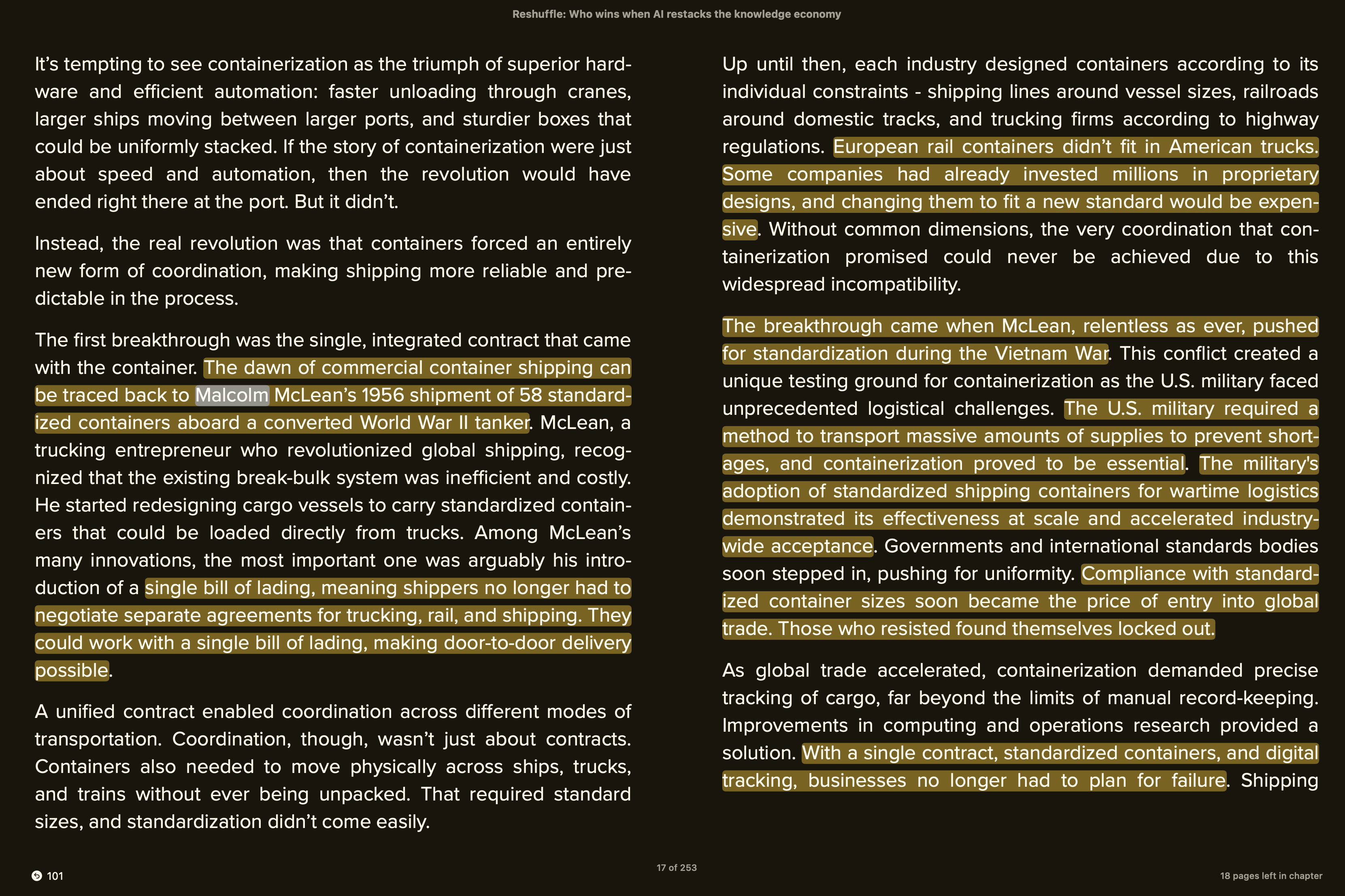
What actually changed global trade was coordination. Not coordination as goodwill, but coordination as enforced compatibility. Before containers, cargo already moved across the world. Empires depended on it. But every sack, crate, barrel, and bundle carried its own assumptions. Every port spoke a different language. Every rail system optimized for itself. European rail containers didn’t fit American trucks. Shipping lines designed around vessel constraints. Trucking firms designed around highway rules. Everyone invested millions in proprietary formats that made sense locally and broke globally.
Value moved, but it moved expensively. Slowly. Unreliably. With constant renegotiation.
The breakthrough wasn’t the box. It was the refusal to let the box keep changing.
Malcolm McLean spent years redesigning vessels, not because the world asked him to, but because nothing else would scale. When standardized containers finally began to move, they forced something radical: a single integrated contract, a single bill of lading, a single set of dimensions that didn’t care which company, port, or country touched them next. Once those dimensions stabilized, everything else reorganized around them. Ports changed. Labor changed. Insurance changed. Governments eventually stepped in, not out of idealism, but because standardized containers became the price of entry into global trade. Those who resisted were locked out.
The network exploded only after the protocol stopped moving.
That distinction matters more today than it did then.
Human value today looks like pre-container shipping.
Time is captured everywhere, but never in the same way. The state captures time through macro aggregates. GDP absorbs human activity into quarterly abstractions where individual lives disappear into growth rates and productivity ratios. The market captures time through salaries and cost-to-company calculations, where a human being shows up as an expense line that must be justified, optimized, and eventually discounted in a DCF model. Communities capture time through volunteering, loyalty, identity, and purpose, often without any economic accounting at all, until exhaustion sets in and people quietly leave.
Every institution depends on human time. None of them share a standard for valuing it.
So coordination stays expensive. Politics fills the gap. Power interprets what math refuses to standardize.
This is the mess the Internet of Value started inside of.
Not as a movement. Not as a moral argument. As an attempt to do for human time what containerization did for cargo: force the system to agree on fewer, harder words.
The mistake most systems make is trying to fix outcomes before fixing vocabulary. More incentives. Better culture. Smarter governance. But without shared containers, all of that collapses into interpretation.
Over the last six years, almost everything that didn’t survive pressure was removed. What remained was not elegant. It was stubborn.
Value capture kept breaking unless wellbeing was accounted for. Value capture kept breaking unless value entered a commons instead of dying inside individuals. No amount of rhetoric could change that.
Eventually, the equation stopped breaking:
VC = W × Vcom
VC = Value Created / Captured
W = Wellbeing Score
Vcom = Value attested by the commons (community / state/ market)
Not because it was clever, but because it was unavoidable.
If wellbeing trends to zero, value capture trends to zero. Burnout is not a moral failure. It is a mathematical one.
If value never enters a commons, value capture trends to zero. Private output does not compound socially.
This equation is not a slogan. It’s a constraint. Everything else in the system exists to make it computable.
Once that constraint stabilized, the protocols underneath it stopped being negotiable.
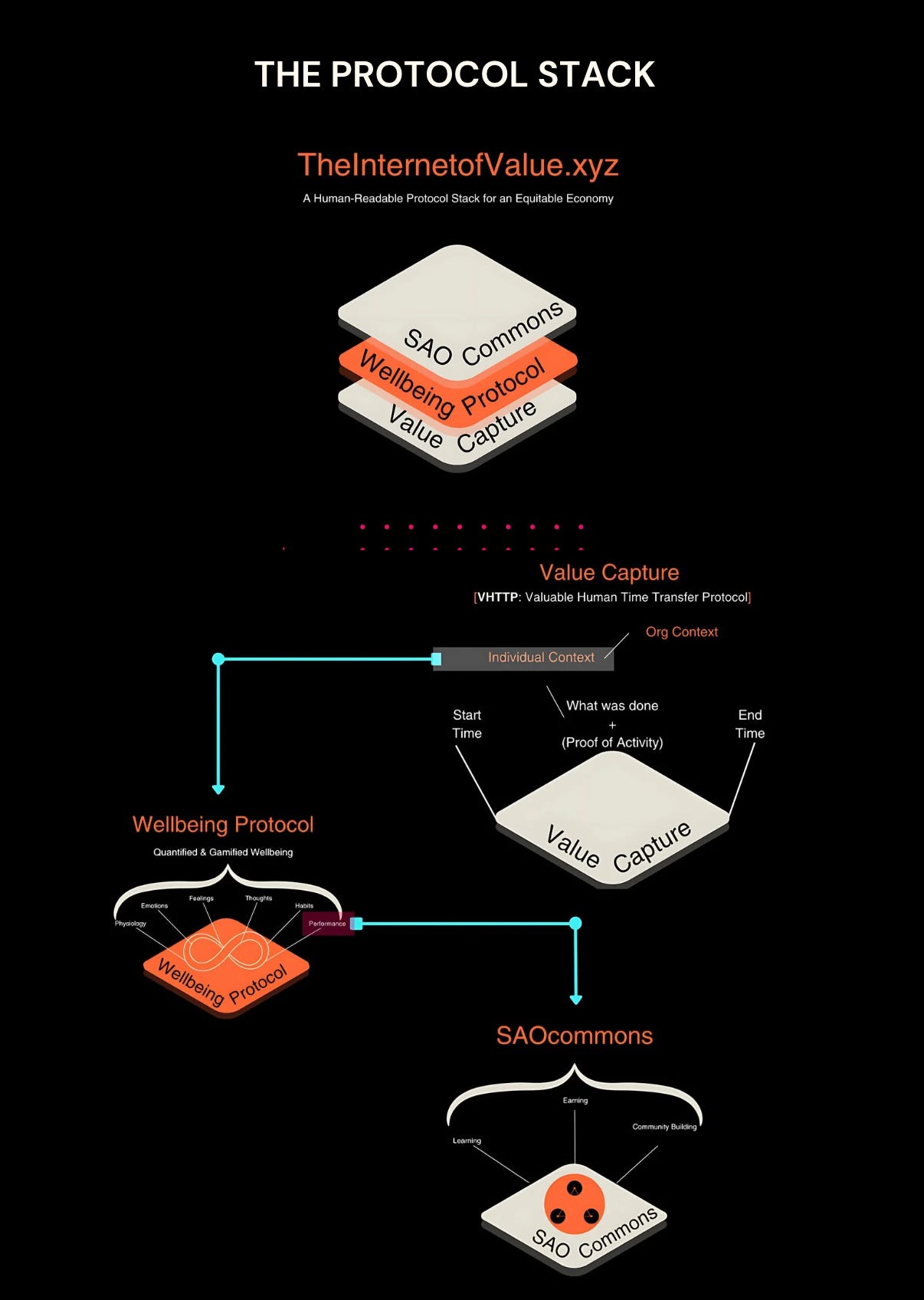
~ValueCaptureProtocol
~~StartTime
~~EndTime
~~Activity
~~ProofOfActivity
~WellbeingProtocol
~~Physiology
~~Emotions
~~Feelings
~~Thoughts
~~Habits
~~Performance
~SAOcommons
~~Learning
~~Earning
~~Org-Building
Time refused to be poetic. It only submitted to four questions: when did it start, when did it end, what happened, and can it be proven. Anything less precise collapsed into storytelling. Anything more precise collapsed into surveillance.
Wellbeing refused to be inspirational. It only remained meaningful when treated as system state. Physiology, emotions, feelings, thoughts, habits, performance. Not because these are fashionable categories, but because they are the layers where capacity actually degrades or compounds over time.
Commons value refused to be vague. It only persisted when it strengthened learning, earning, or the ability to build organizations that outlast individuals. Everything else was contribution theater.
These words were not chosen. They were what survived.
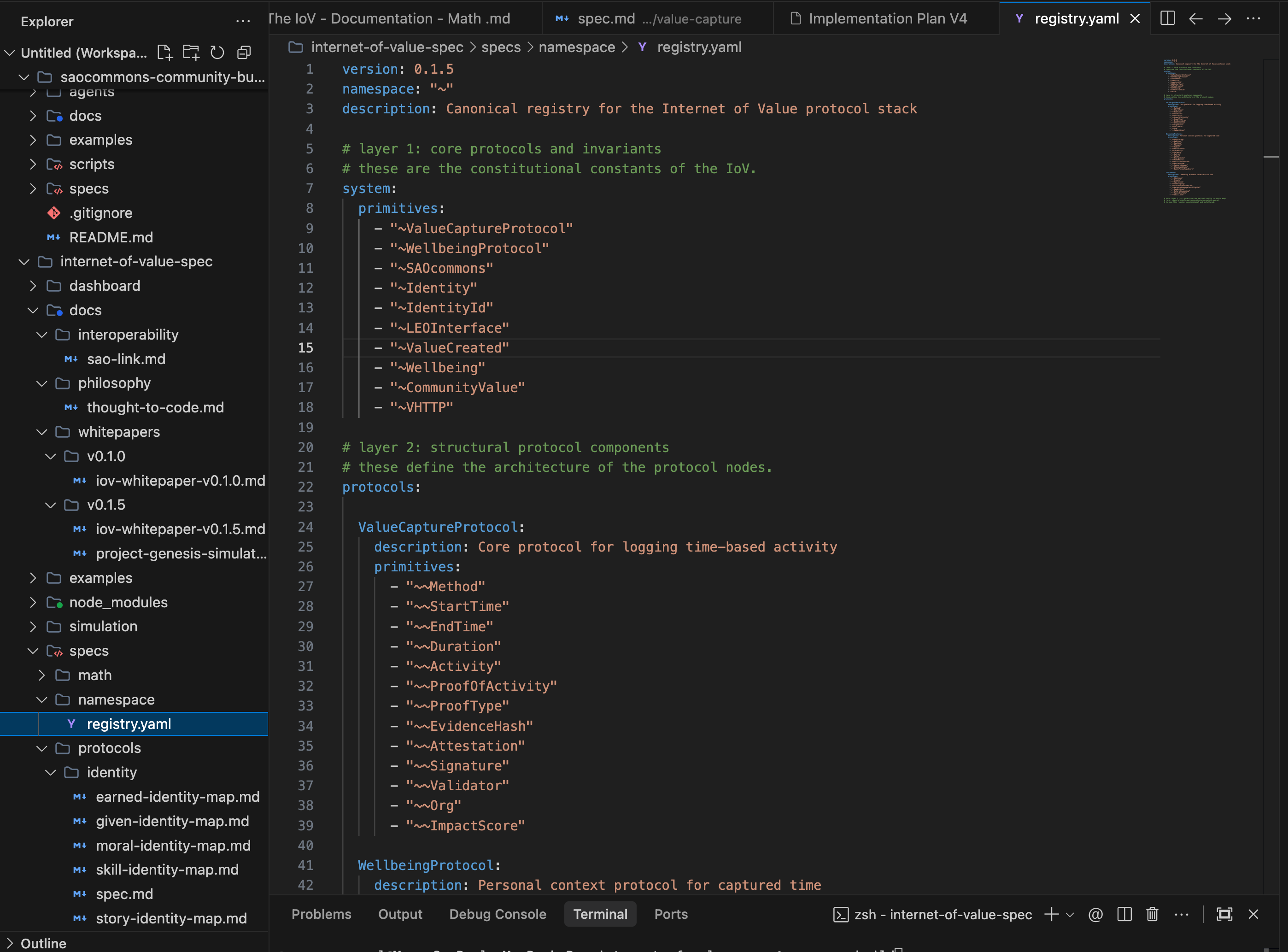
This is what the Internet of Value course is actually doing. It is not onboarding people. It is standardizing containers. It is making sure that when we say “value,” “time,” “wellbeing,” or “commons,” we are not each smuggling our own proprietary formats into the system.
Protocols vs Networks
This is also why the distinction between protocols and networks matters so much.
The Internet of Value protocol stack is open by necessity. Containers must be inspectable. Dimensions must be public. Anyone should be able to argue with the vocabulary, test it, or try to break it.
But the network need not start open. For the last 6 years I’ve built a few communities that were open and realised the community falls down to the level of the lowest performing member. So am intentionally keeping it closed now.
It’s OPEN only for folks who have finished this course and then contribute to the open protocol stack.
Not because openness is bad, but because premature openness destroys standards. When incompatible cargo enters too early, coordination costs explode again. You don’t get scale. You get dilution.
Shipping didn’t become global because everyone was welcome to load anything they wanted into a box. It became global because the box stopped caring who owned it and started caring what fit inside.
The course exists for the same reason. It’s not a paywall. It’s a cognitive checksum. A way to ensure that the first people inside the system are packing value in compatible ways.
Only after the protocol stabilizes does the network deserve to open.
There is another consequence of getting this right, and it’s the one most people miss.
When individuals are measured properly, they stop being treated as costs.
Today, in markets, humans appear as expenses to be minimized. In states, they appear as statistics to be managed. In communities, they appear as infinite sources of goodwill until they burn out.
A richer wellbeing score, combined with verifiable value capture and commons contribution, changes that. It allows individuals and skill-based communities to be treated as assets with future value, not liabilities on a balance sheet. Discounted Value Flow becomes possible, not just for companies, but for humans and collectives. Risk-adjusted future contribution replaces static cost accounting.
When that happens, respect stops being ethical and starts being economic.
Not because institutions grow kinder, but because the math changes.
This is why the protocol stack must be open. Vocabulary is infrastructure.
This is why the network is closed for now. Standards need time to harden.
And this is why collaboration is invited only after understanding, not before.
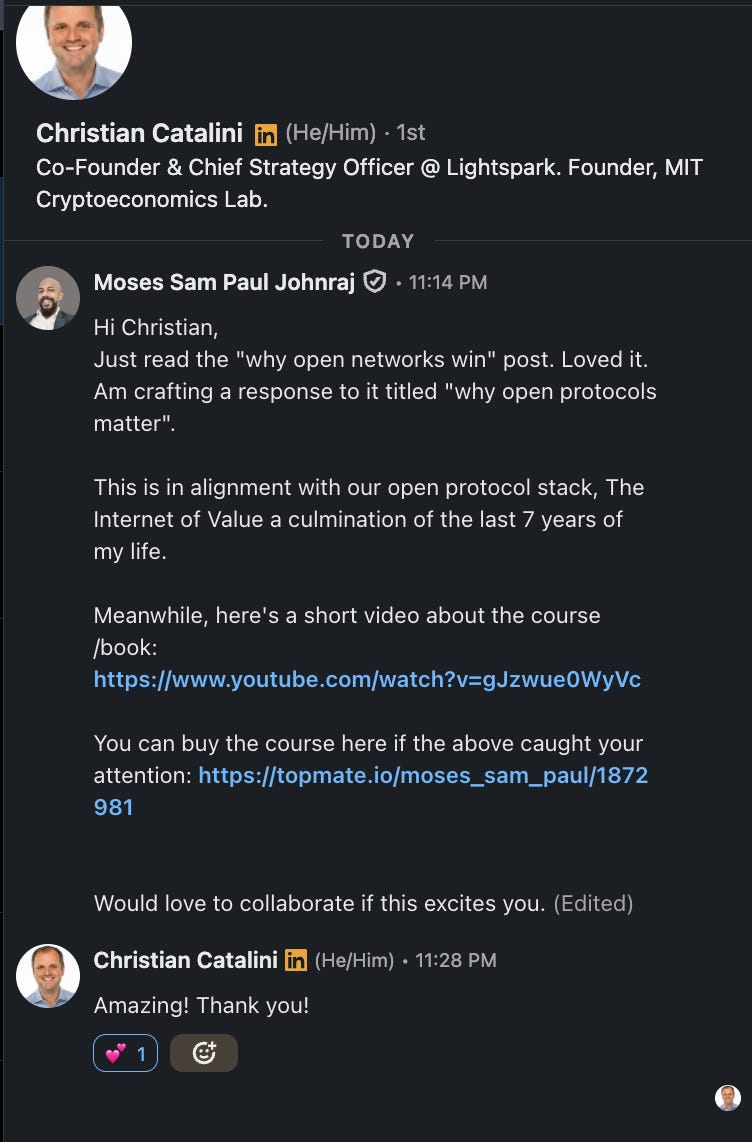
Not everyone who wants to ship cargo understands containers. That’s not elitism. That’s how systems survive scale.
The Internet of Value is an attempt to standardize human value before it is once again captured by institutions that already know how to price it, but refuse to see it.
The work now is not to add more words.
It’s to make sure the few that remain do not move.
If there’s better Go-To-Market strategy for a better internet that optimises for individual wellbeing through skill-based communities thus creating an equitable economy, please comment, am all ears!
Thank you,