The Origin Story
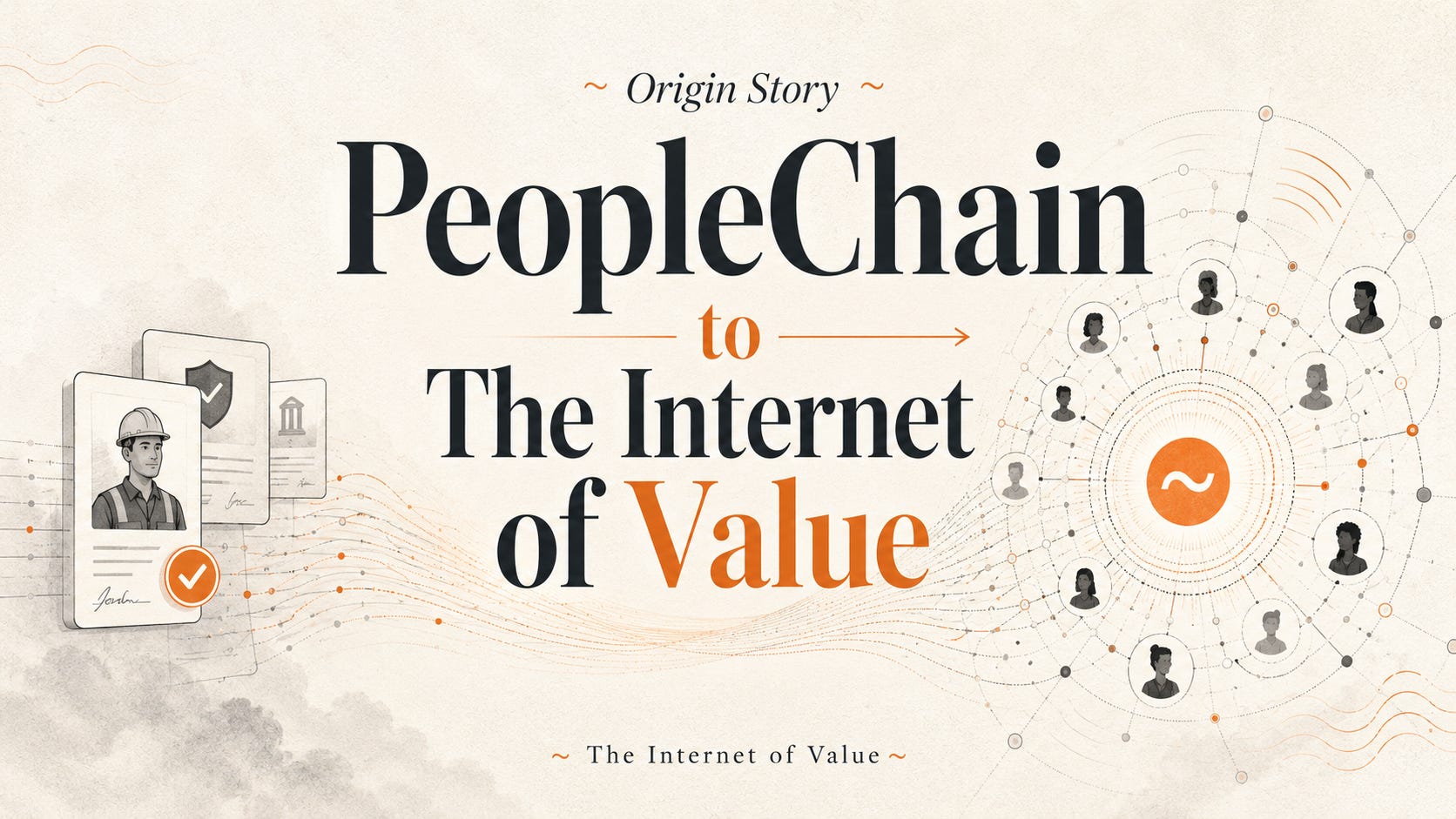
From PeopleChain to The Internet of Value

“This is probably the fastest $1.5 million ever raised.”
Ajit Isaac said this to Vijay and me sometime around May 2017. Ajit is the founder and chairman of Quess Corp (NSE:QUESS), one of India’s largest workforce-management companies. Vijay was the CEO of Heptagon, a digital-transformation company then backed by Quess. I was Heptagon’s Head of Growth.
We had entered the room with an idea called PeopleChain.
At the time, blockchain seemed to offer a solution to almost every problem, including several problems that did not exist. But the problem we were looking at was painfully real: moving a worker through the Indian labour market involved enormous friction.
Quess had given us a front-row seat to that friction. It recruited and deployed workers across industries, from information technology and retail to logistics and frontline services. Every appointment carried paperwork, verification, coordination and delay.
We had already helped digitise one part of that machinery through a Paperless Onboarding Platform. A process that had taken approximately seven days could now be completed in fourteen minutes.
That result changed the question.
Once onboarding was no longer the principal bottleneck, what came next?
Could search and matching become easier? Could credentials travel with the worker? Could skills be validated continuously rather than reconstructed during every job change? Could background verification become incremental rather than beginning from zero each time a person entered a new organisation?
Our initial proposal was relatively modest.
Once a worker had been background-verified, a trusted record could be written to a private network accessible to authorised organisations. When the worker changed jobs, only the new employment record would need to be verified and added. Instead of repeatedly investigating the same history, employers could build upon an existing chain of validated information.
That was PeopleChain.
The idea was not to value human beings. It was to remove a particular friction from the movement of labour.
But the question refused to remain that small.
If employment history could become portable, what about skills?
If skills could be validated, what about the time spent acquiring them?
If we recorded how people spent their time, could we distinguish between time spent learning, earning, recovering, caring and building institutions?
Who would validate those activities?
Who would capture the value they created?
And what kinds of institutions would be required if value were recognised not only by an employer or a market, but also by a community?
A proposal for incremental background verification slowly expanded into a much more difficult question:
Can we build an economic system that recognises human time, wellbeing, skill and contribution without reducing a person to productivity or price?
That question became The Internet of Value.
The project that would not disappear
The path from PeopleChain to The Internet of Value was not clean, heroic or inevitable.
There was no uninterrupted march from a corporate presentation to a grand economic protocol.
The original project stalled. Blockchain enthusiasm collapsed under the weight of speculation and bad incentives. Funding priorities shifted. Then the pandemic arrived and disrupted almost everything.
I stepped away from Heptagon in November 2019 and continued the work independently. PeopleChain became SkillChain for a while, because the project was no longer merely about employment records. But even that name eventually became too narrow.
Meanwhile, I found myself building and participating in communities that appeared unrelated on the surface.
There was Quantum Computing India, an attempt to make an intimidating emerging field less inaccessible. There were communities concerned with startups, growth and learning. There was Stranger Sapiens, which explored identity, culture and the strange stories human beings use to organise themselves.
At the time, I could not fully explain what connected them.
I only knew that something kept pulling me towards the same set of problems.
How do people become capable?
How does a skill become visible?
How does a community recognise contribution?
Why does valuable human activity disappear when no employer pays for it?
Why can organisations account for money with extraordinary precision while individuals struggle to account for their own time, wellbeing and transformation?
Over several years, the project expanded from labour-market infrastructure into a larger abstraction.
I began calling it The Internet of Value.
Not because the internet should place a price on every human action. We already have enough machinery attempting that.
The ambition is almost the opposite.
The Internet of Value asks whether human time, wellbeing, skill and contribution can become more legible without turning the person into a commodity, a productivity score or a profile owned by someone else.
Our institutions keep asking human beings to prove their value through systems that were never designed to see most of it.
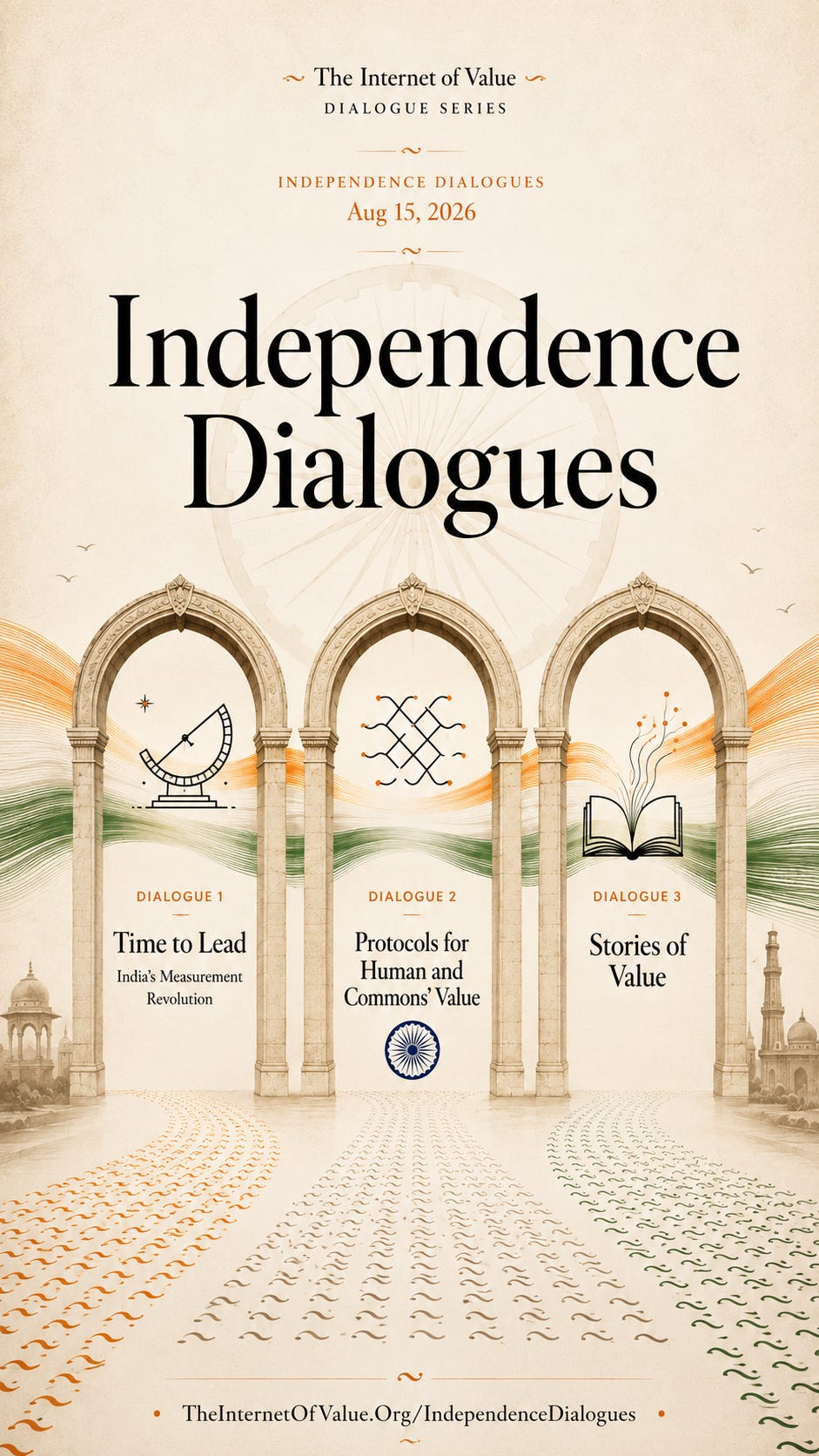
On 15 August 2026, I will bring this work into public dialogue through the Independence Dialogues in Bangalore.
The three conversations will explore human time, the protocols required to represent human and community value, and the stories through which societies decide what counts.
The project began with a question about verification.
Nine years later, the question is no longer whether we can verify a person’s past more efficiently.
It is whether we can build institutions capable of recognising what that person is becoming.
Learn more about the Independence Dialogues:
https://theinternetofvalue.org/independence-dialogues