
On Learning From Imperfect People
#GratitudeSeries

Yesterday’s #GratitudeSeries post was about Richard Feynman & got an email which made me think. Hence this post.
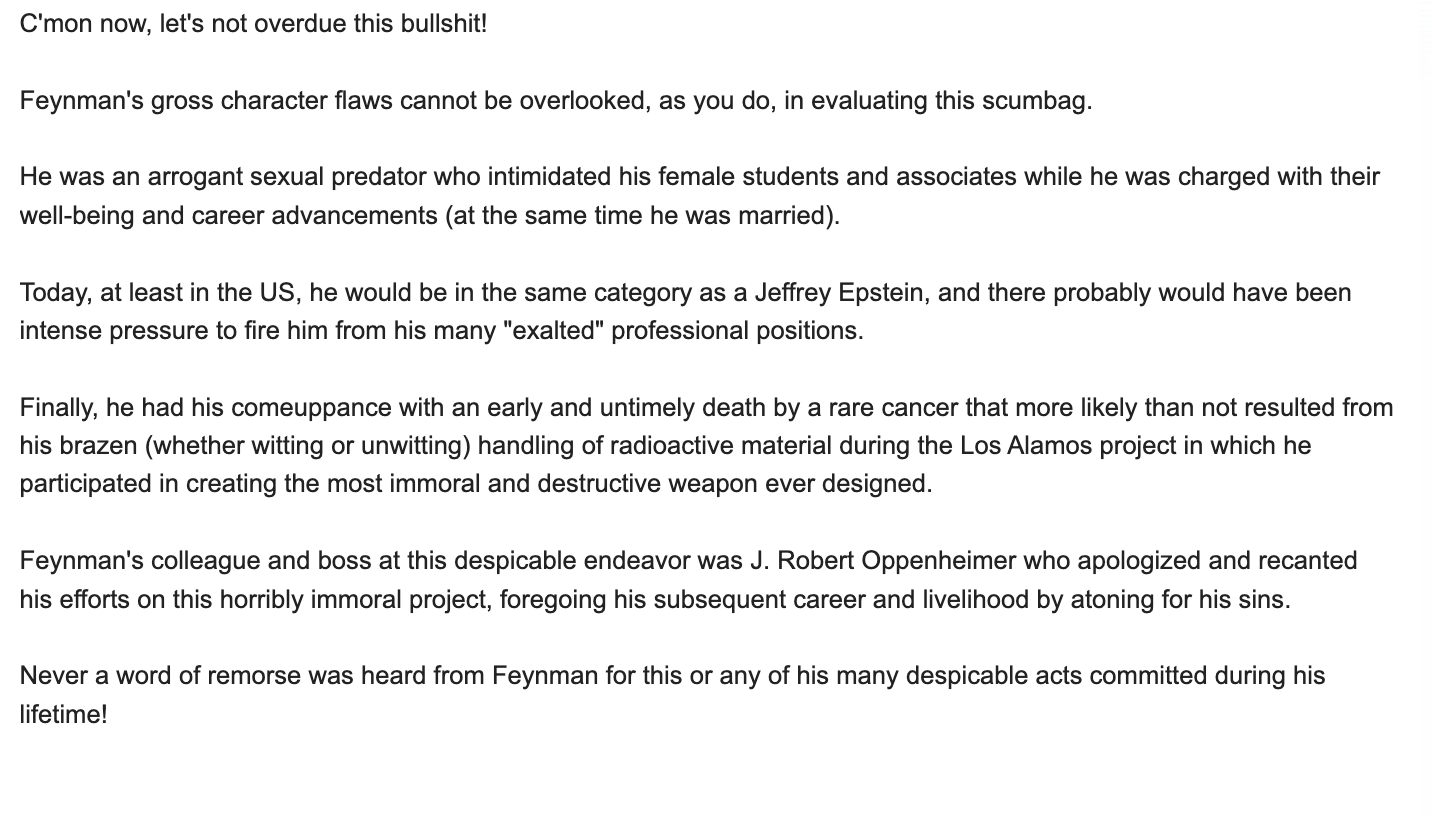
My Response:
Thanks for writing in.
I am not canonizing Richard Feynman as a moral exemplar, nor dismissing serious allegations about his behavior. The piece was narrowly about what I personally learned from his approach to curiosity, skepticism, and first-principles thinking during a difficult problem I was trying to solve in my own journey.
This is a recurring human problem. Insight does not arrive packaged with virtue. We can acknowledge wrongdoing, hold people accountable, and still extract ideas that survive independent of their origin. If we required moral purity as a prerequisite for intellectual usefulness, most of science, art, and philosophy would be unusable.
That separation is not absolution. It is a practical distinction between evaluating actions and evaluating ideas.
If that distinction does not resonate, that is fair. The essay was written to explain why those ideas mattered to me, not to settle the ethical ledger of 20th-century physicists.
I appreciate you taking the time to write.
On Learning From Imperfect People
A recurring tension keeps resurfacing whenever we talk about thinkers, artists, or scientists from the past.
If a person behaved badly, does that invalidate everything they thought, built, or articulated?
It is a fair question. It deserves a precise answer, not a shouting match.
Human history is messy. Insight does not arrive through morally sanitized vessels. If it did, our libraries would be thin, our sciences underdeveloped, and our understanding of reality dangerously shallow. The uncomfortable truth is that ideas often outlive the people who produced them and they do so because ideas can be tested, falsified, reused, and improved independent of biography.
This is not an argument for excusing harm. Accountability matters. Harm matters. Context matters. But collapsing all evaluation into a single moral verdict creates a different problem. It replaces thinking with sorting. Saints keep their ideas. Sinners lose theirs. Reality does not work that way.
When I write about learning from someone, I am not offering them moral immunity or erecting a statue. I am describing how a particular way of thinking helped me navigate complexity, uncertainty, or confusion at a specific moment in my own life.
That distinction matters.
Separating ideas from people is not a trick to avoid ethics. It is a way to preserve intellectual progress while still being honest about human failure. The alternative is not moral clarity. It is cultural amnesia.
We can hold two truths at once.
A person can be deeply flawed.
An idea can still be useful, beautiful, or true.
If that tension feels uncomfortable, good. Thinking usually is.
Thanks for writing this; it clarifies the crucial distinction between evaluating ideas and assessing an individual's ethical ledger, a nuanced and essential perspective.