
India’s Most Valuable Resource Is Not Labour.
Aug 15 - Independence Dialogues - Time to Lead - 2/10

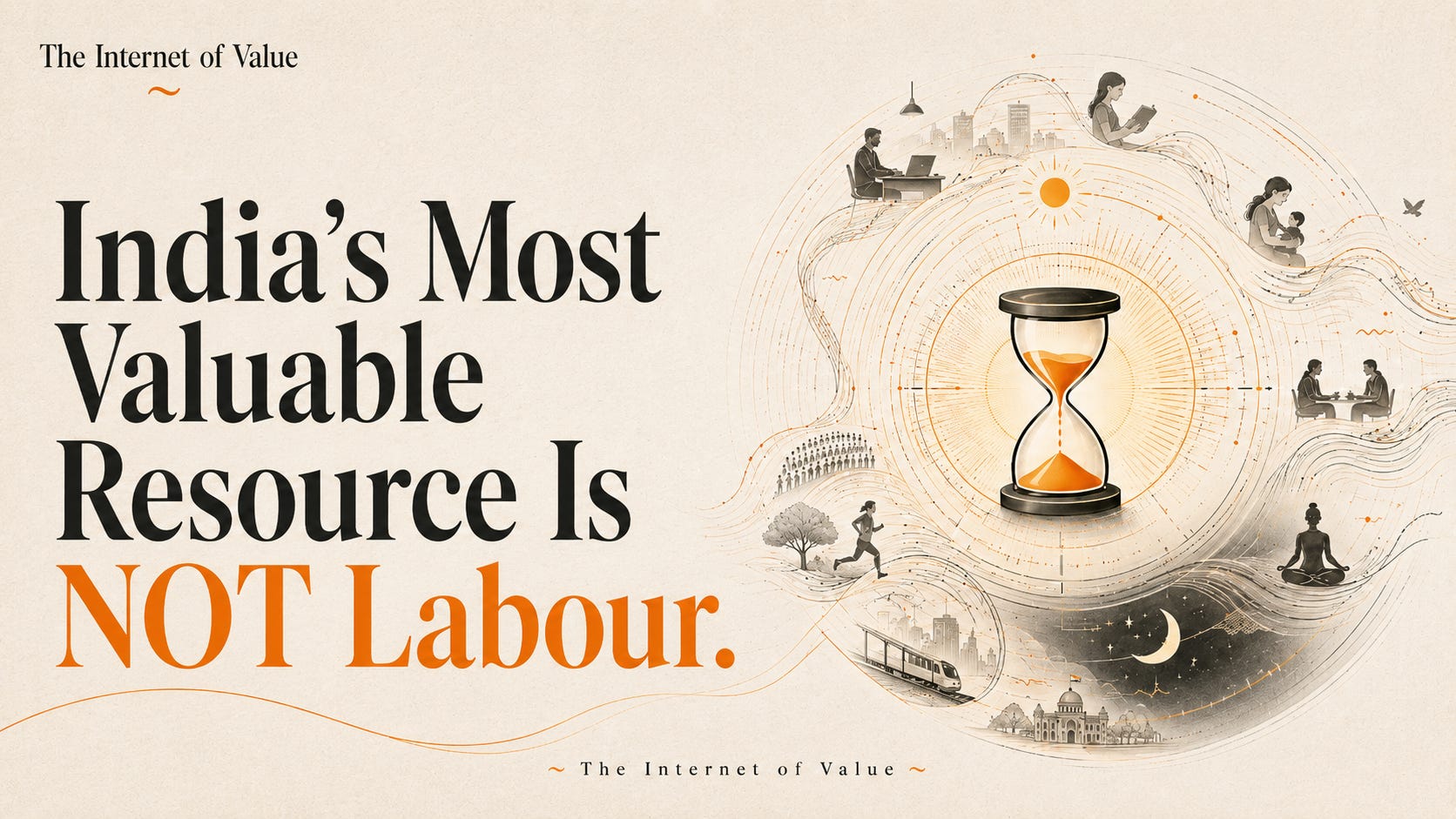
On 23 July 2026, I recorded my day using the Value Log, a prototype I have been building as part of The Internet of Value.
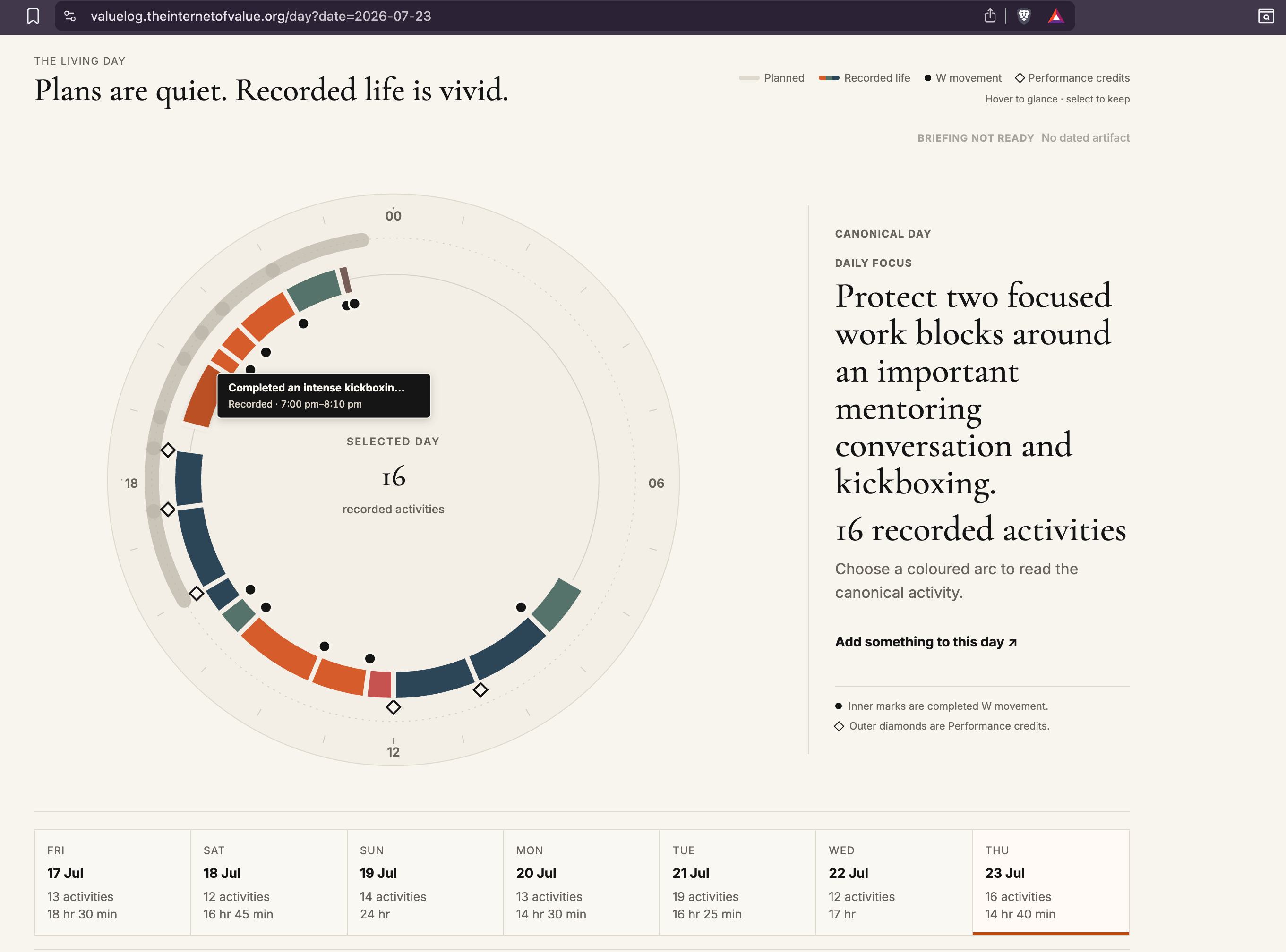
The log did not contain anything heroic. I worked on the product, published a newsletter, spoke with a bank manager, talked to my mother, took a recovery nap, met a friend and mentor, trained at the gym and walked home.
That ordinariness is what makes the record useful.
One day represented across work, relationships, recovery, habits and institution-building. The numbers shown belong to an experimental protocol and will be explained separately.
What happened during the day?
The record contains several kinds of human time:
Physiological maintenance: food, rest, exercise, steam, shower and recovery.
Relationships and emotional life: a conversation with my mother and time with a long-term friend and mentor.
Economic activity: publishing a newsletter and speaking with a bank manager.
Skill and product development: redesigning the Value Log and fixing identity-related product issues.
Institution-building: explaining seven years of work, testing the underlying ideas and developing The Internet of Value.
Existing systems would recognise only fragments of this day. A bank could record the transactions. A calendar could record the meetings. A computer could record the applications used. A fitness device could record the workout. Each system would see the part relevant to its own purpose, but none would hold a coherent account of what happened to the person across the day.
This is not merely a limitation of personal tracking. It reveals a larger economic problem.
We count people, but we do not account for their time
India is usually described through the scale of its population. We speak of people as workers, consumers, voters, students, taxpayers, entrepreneurs and beneficiaries. Depending on the argument, the population becomes either a demographic dividend or a burden.
Both positions count people. Neither adequately accounts for their time.
Population is a stock. Human time is a flow.
Every morning, more than a billion individual days begin across India. People travel, cook, clean, care, recover, study, search for work, perform paid labour, acquire skills, maintain relationships and build communities. Twenty-four hours later, those days are gone.
Some of that time becomes wages, invoices, sales and measurable economic output. Much of it leaves no recognised record.
Labour is only the portion of human time that existing institutions know how to organise, purchase and measure. Human time is the larger field from which labour emerges. It contains learning before the credential, recovery before renewed performance, care that enables another person to work, and community-building before a formal organisation exists.
The absence of wages does not mean the absence of value.
A person caring for a parent may not appear economically productive. Someone learning independently may remain invisible until a company recognises the skill. A founder developing an institution without revenue may appear to be doing nothing. A worker teaching a colleague may improve the entire organisation while receiving no record of that contribution.
The economy does not always declare these activities worthless. More often, it simply lacks the language and institutions required to see them.
The purpose is not to price every hour
Making human time visible carries an obvious danger. The same infrastructure could become a system of surveillance, productivity scoring and behavioural control.
Employers could demand access to wellbeing data. Platforms could rank people by desirable habits. Communities could become moral gatekeepers. Every private act could be pushed towards measurement and economic justification.
That would not be an Internet of Value. It would be a more intimate version of the extraction systems we already have.
Nor should every valuable activity be monetised. Recovery has value, but it does not need an hourly market price. A conversation with a parent can affect emotional wellbeing without becoming an economic transaction. Exercise can increase a person’s capacity without turning the body into an asset owned by an institution.
The goal is not to convert life into labour.
The goal is to make human time legible without reducing the person to productivity or price.
That requires distinctions between private and public records, wellbeing and performance, personal meaning and economic value. It requires consent, contextual identities and communities capable of recognising contribution without claiming ownership over the whole person.
From cheap labour to valuable human time
India has often competed through the relative affordability of its labour. That strategy helped build industries and create livelihoods, but it becomes increasingly fragile as automation and artificial intelligence reduce the cost of both physical and cognitive tasks.
A country whose advantage is that its people cost less will eventually compete against machines and people who cost even less.
India needs a more ambitious proposition:
Our institutions help human time become healthier, more capable, more visible and more valuable.
That shift begins before employment. It begins with the ability of individuals to understand where their time goes, how it changes them, what capabilities emerge and which communities benefit.
One person recording one day will not transform an economy. But shared protocols could eventually help people demonstrate skills through practice, understand the relationship between time and wellbeing, and make contributions visible before they become formal employment.
India’s most valuable resource is not labour in the narrow economic sense. It is the finite and irrecoverable human time from which labour, learning, care, creativity and institutions emerge.
The question is whether we will continue recognising that time only after a market purchases it.
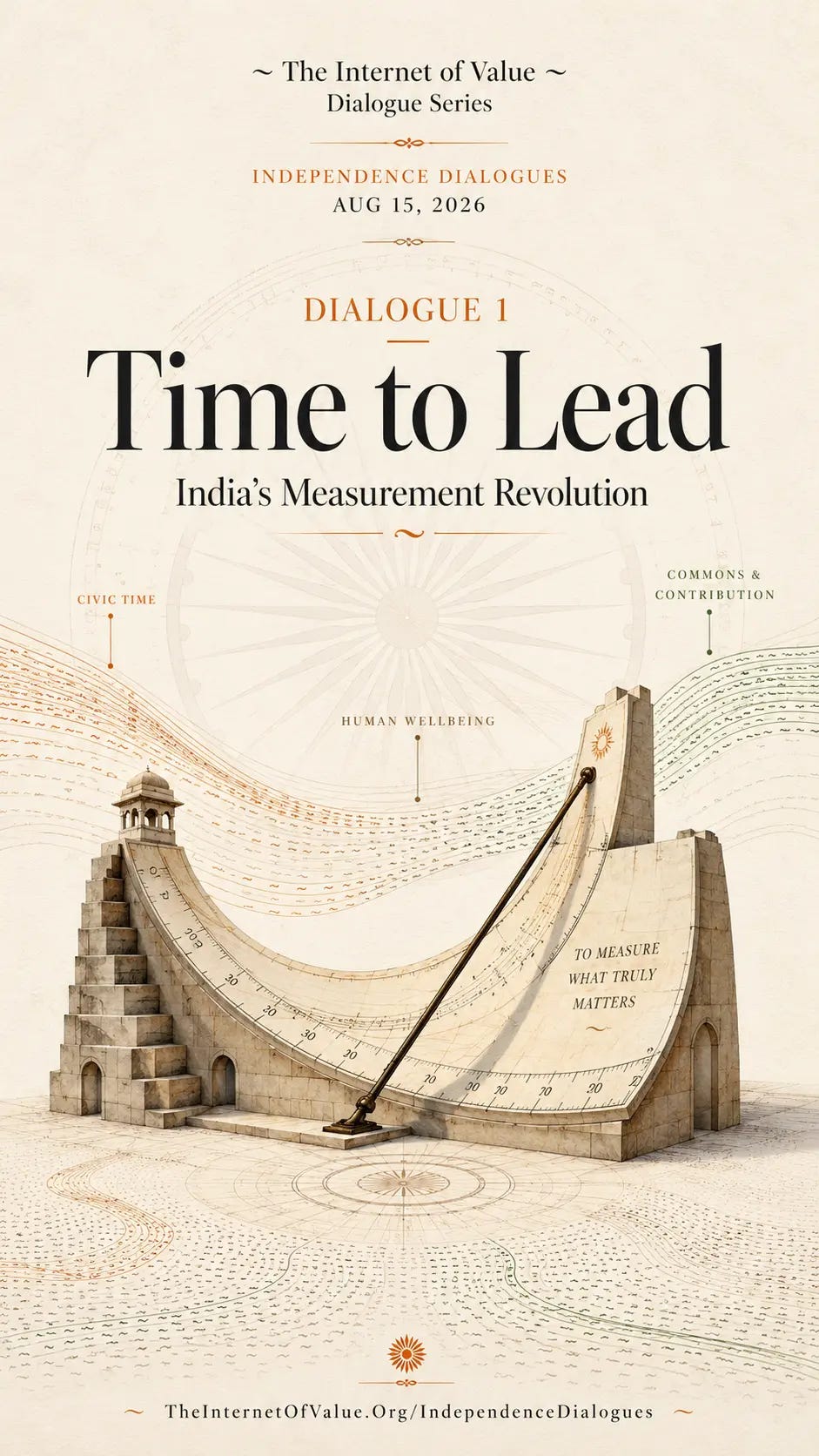
On 15 August 2026, the first Independence Dialogue, Time to Lead: India’s Measurement Revolution, will explore what it would mean for India to begin measuring human time differently.